
The Neemtree
The Neemtree
All life follows the law of “to eat and to be eaten” in order to survive as a species over the course of many millions of years. Therefore strategies for protection from its enemies had to be developed. As an example we only need to consider the biblical plagues with the giant swarms of locusts, which even today still scour bare whole country sides, leaving their residents to suffer from starvation. Or think of the many insect pests that damage agricultural crops. Or of other insects that transmit diseases to humans or plants, such as malaria, sleeping sickness or plant viruses. Other insects can be directly or indirectly responsible for the development of allergies. We had to develop chemical repellents and insecticides to protect ourselves but must also face the consequences of an increasing tolerance against these chemicals. This is part of the reason why there is a growing interest in natural products, both for direct application and as models for the development of new synthetic molecules. The neem tree offers an attractive source of growth inhibitors and repellents for insects and mites.
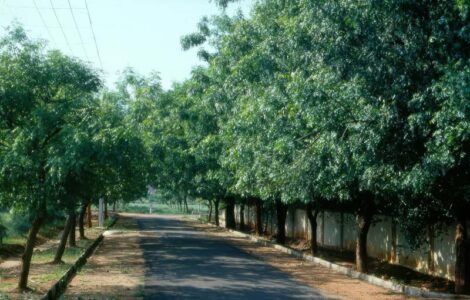
It is interesting to study the strategies developed by plants over millions of years to protect themselves from pests and, in particular, to learn how many chemically interesting substances nature offers us in this way. Let us consider locusts again. After the ravenous swarms have destroyed everything green and moved on, one tree and its leaves remains untouched: the tropical neem tree. For this reason, the tree has been revered in India as a “holy tree” since ancient times, and extracts from its leaves or seeds have been used in traditional medicine and agriculture from long time. It is common to have a neem tree nearby one’s house to repel mosquitoes. Or branches from the tree are placed between wool sacks to protect against moth damage in storage. For instance, carpets stored in this way were still completely undamaged after they had been stored over one hundred years. This type of moth protection is also common in Africa, where neem trees are growing plentiful.
Terra Nostra has concentrated its interest on the repellents of the neem Margosa Extract. These compounds offer the type of prophylaxis which protects the target from its infestation by the pest. However, there is no general effect by the extract and its formulations. The repelling effect on the respective organism has to be tested therefore. More details are presented in the following chapters.
Prof. Dr. H. Rembold
Terra Nostra GmbH